Wednesday, May 27, 2009

The Real Hollywood Ten


The Hollywood Ten were humanitarian heroes. They were ten individuals, who were fired for holding certain beliefs, beliefs which just happened to be communist. These individuals were fired from top paying jobs that carried a great amount of respect. They were fired for the heroic deed of defying congress and their employers. This belief is common today in a world heavily influenced by leftist Hollywood, and it is also a load of baloney. The public is content with believing the farce put forth by Hollywood and other ‘intellectuals’ that these people were innocent victims accused merely of thinking. Whenever one mentions communists and a threat of losing a job there is an enormous uproar. ‘Witch-hunts’ they say. No one should be forced to say what their ideological viewpoints are to keep a job. Nonsense, of course they can.

When a businessperson opens up shop, puts their blood, sweat, tears, money, and more into their business; they have every right to decide who can and cannot work in their place of business. This is a fact many intellectuals of our time – and times past – wish to skew. To them, everyone has a ‘right’ to a job, even at the expense of the business owner. After all, it is the workers who are doing all of the ‘work.’

That’s one way of looking at it. Another way is this. When a business is opened up, the capital put forth; what is the first thing a businesswoman must do? Spend money. They must spend money on construction, or renting an office building, telephones, faxes, internet and more. They must also hire workers, and pay for advertisement. This is done before the proprietor sees one cent of profit. Many times an entrepreneur must take a loss for up to 5 years or more before seeing any returns. Yet the people still continuing to be paid are the workers, the companies that provide telephone service, internet service, cleaning service, and so on. Each of those companies receives money from the businessperson and is able to pay their workers. If a business does not pay its workers, it will inevitably lose those workers and go bankrupt.

To assume that workers in Hollywood should be any different is just the elitist attitude that is the major problem. The Hollywood Ten and any other worker is accepted and hired to work at a particular place of business on the basis of the business’s requirements. Businesses do not grow in nature. Men and women must start them and make them work. Since the entrepreneur is putting up all the risk, it is their right to hire whom they wish. If the owner chooses it is not in the best interests of their company to hire a person for any reason that is their choice. As the business owner, they will have to live by their choices. If the executives in charge of Hollywood during the 40s decided that having communists in their employ was detrimental to their success, they have every right, and obligation, to terminate their contracts.

A book entitled Ayn Rand and Song of Russia: Communism and Anti-communism in 1940’s Hollywood by Robert Mayhew, attempts to put the record straight as to the farce of intellectual deterrents put up over the last fifty plus years. Song of Russia is a movie produced in 1943 with such obvious propaganda as to show every Russian as a happy little peasant enjoying life in Stalinist Russia, and to show such things as these peasants enjoying a bountiful harvest. This at a time when even the Russian government admitted to an enormous famine which killed – according to their government – an estimated ten million people (many accounts say much more than this). It shows the two heroes of the movie dancing in a luxurious club, while in the real world millions were killed by maniacal dictatorship. It claimed the peasant farmers ‘owned’ their tractor, even though they lived in a place where no one owned anything. It presented the female lead, a peasant girl named Nadya, traveling from a small town into Moscow. While excluding the GPU agents and other massive obstacles to her progress of attaining a pass to enter Moscow.
In the book Mayhew succinctly covers the massive changes the script undertook, at the behest of many very dubious characters; as well as Ayn Rand’s testimony to the House Un-American Activities (HUAC) congressional board in 1947. The author introduces his book with a sentence told to Ayn Rand which motivated her throughout the rest of her days.


At a bon voyage party for Ayn Rand in January 1926, before she left Russia for
the United States, a gentlemen approached her and said: ‘When you get there,
tell them that Russia is a huge cemetery and that we are all dying.’ This is
what Ayn Rand spent her life attempting to proliferate to the world.


Today there are many claims presented as the atrocities the Hollywood Ten - and others who were supposedly prosecuted by congress during the three periods of the investigations towards Hollywood in 1947, 1951-52, 1953-55 - underwent. The claims touted are always the same; these ‘Ten’ and their comrades were heroes who were standing up for the Bill of Rights, for freedom of speech and more.

What these supposed advocates of freedom fail to acknowledge – or refuse to acknowledge – is the differentiation between the ideological and the physical. This is what is meant by the Bill of Rights. The idea of civil liberties i.e. free speech, free assembly etc applies and belongs only in the realm of ideas. Once those ideas cross into physical violence, they become null and void. What the HUAC (House Un-American Activities) was investigating was not merely what their ideological viewpoints were, but whether or not those under question were a card carrying member of the Communist Party. Indeed they carried cards. Being a member of the Communist Party meant much more than simply believing in what the communists believed, it meant adhering to their creed and law. It meant taking orders. It meant belonging to an organization of murder, violence, sabotage, and spying. This moves the individuals being investigated from the realm of ideas into criminal law. Moreover, those who were card carrying members also received their orders from a foreign government, which puts them in the realm of treason and military law. The Congressional hearings were correct in their condemnation.

To further elucidate this point I refer to Ayn Rand’s commentary on her HUAC testimony regarding communist membership.
Membership in the Communist Party is a formal act of joining a formal
organization whose aims, by its own admission, include acts of criminal
violence. Congress has no right to inquire into ideas or opinions, but has every
right to inquire into criminal activities. Belonging to a secret organization
that advocates criminal actions comes into the sphere of the criminal, not the
ideological…


As she further states, allowing members of the Communist Party is like saying it is ok for a certain religious sect to practice religious sacrifices. The members of that religious sect would be persecuted for murder. Their ideological backing would have no merit on the trial. The same logic applies to the HUAC hearings, although Congress seemed to pursue these villains with a half-hearted vigor.

The fact that the Hollywood Ten claimed they did not want to reveal their connection to the Party because they would lose their jobs, only indicates their perpetration of a fraud. It attests to the fact that they wished to conceal information from their employers, co-workers, customers and the general public. That people would not deal with them if they knew the truth only shows the gravity of their wrongs. By condemning Congress for not allowing the Hollywood Ten to commit their crimes is a mockery to the idea of individual rights and the Rule of Law. This is equivalent to a con artist saying to congress that if they force them to reveal their con then the jig is up for them and they will lose their livelihood.

The false idea being pushed around the intellectual forum today that these supposed heroes were fighting for their freedom of speech is ridiculous. Again, free speech wasn’t an issue. The issue was whether or not these people were in fact members of a party which would kill any of their own people to keep them quiet. Ironically enough, as these Ten were portraying their viewpoints of Stalinist Russia in American movies, an atrocity rarely heard of was being carried out by that evil dictator; the extermination of the Lubyanka Thousand. The Lubyanka was a Moscow headquarters of the Soviet secret police. Many innocent people were imprisoned, tortures, and killed there. The Lubyanka Thousand were the over one thousand writers murdered there.

Monday, May 25, 2009

A Supreme Let Down

As many American’s are aware, Supreme Court Judge David Souter is now retiring after 19 years. This gives President Barrack Obama the opportunity to exercise one of his most important executive powers; to appoint the next Supreme Court Justice. Obama has made it very clear his major requirements for the next Supreme Court choice. As he has said on a few occasions “We need someone who’s got the heart to recognize – the empathy to recognize what it’s like to be a teenage mom, the empathy to understand what it’s like to be poor or African-American or gay or disabled or old. And that’s the criteria by which I’m going to be selecting my judges” This bold statement completely refutes the intent of our constitution.

Our framers specifically and painstakingly designed a state that is a ‘constitutionally restricted republic.’ Today, people believe our country is merely a democracy, yet they forget democracy is only one check on the overall state.

A problem with the way America’s state was designed begins to occur when we look at what a state really is.

Murray Rothbard succinctly covered many aspects of the state in his essay The Anatomy of the State. First, understanding the state is not us. This is a common misconception today, that ‘we are the government.’ This sad and ideological term ‘we’ has prevented citizens of a particular state to be unaware of the reality of political life. As Rothbard States: “If ‘we are the government.’ Then anything a government does to an individual is not only just and untyrannical but also ‘voluntary’ on the part of the individual concerned.” As he further explains,
“under this reasoning any Jews murdered by the Nazi government were not
murdered; instead, they must have ‘committed suicide,’ since they were the
government (which was democratically chosen), and therefore, anything the
government did to them was voluntary on their part.”
This reasoning seems ludicrous, but yet, it is completely in line with the common thinking of our time. It must be emphatically stated that we are not the government, and understand what the government is and its general purpose. A state is an organization that has a ubiquitous monopoly on force over a given geographical area. Moreover, it is the only organization which does not attain its monies by voluntary measures; its only means to attaining revenue is force.

There are only two ways a human may attain wealth; voluntary trade, or compulsion. Open hand, or the gun. The state only has one option available to it.

This then leads into the development of our own constitutionally restricted republic. Our founding fathers knew one thing, and that is, if a state is left unchecked it will trample individual rights, as per the states nature. Our founders began with the understanding that individual rights are not granted from god, society, king or any other means – but that individual rights are inalienable. Some may cite the Declaration of Independence’s statement: “That they are endowed by their Creator with certain inalienable rights.” This seems to say that our founders believed our rights derived from god, or something outside of ourselves, yet this is not congruent with what our framers tried to convey. Merely a line before that ‘Creator’ line it states: “…assume the powers of the earth, the separate and equal station to which the Laws of Nature and of Nature’s God entitle them.” It is clear through the writings of our framers what they hoped future generations would retain, and that is our conception of our individual rights. Rights are a moral concept which serves as a transition from the principles which guide each and every one of us individually to the principles guiding our relationship with others. As Ayn Rand wrote, “the link between the moral code of a man and the legal code of a society, between ethics and politics. Individual rights are the means of subordinating society to moral law.” Also in Atlas Shrugged the character John Galt explains, “the source of man’s rights is not divine law or congressional law but the law of identity. A is A and man is man. Rights are conditions of existence required by man’s nature for his proper survival. If man is to live on earth, it is right for him to use his mind, it is right to act on his own free judgment it is right to work for his values and to keep the product of his work. If life on earth is his purpose he has a right to live as a rational being: nature forbids him the irrational.”

There is a disconnect, from what our founders intended, and what they in fact implemented in our constitution. The Supreme Court of the United States of America has the ultimate and last say in the interpretation of our constitution, and it is a part of the government. The masses may believe that the judicial branch of the government is separate from the other two, yet the members are chosen from the executive and legislative branches. This allows the federal government to pick the individuals who will be enforcing the rules they will create, which is like a professional basketball team picking the referee who will ref their games. The basketball team (and the politicians) will obviously pick those people who are most likely to call the game in their favor. So comes to fruition, once again, the battle between state power and social power.

In our system, the best check on this blatant flaw is our president picking the best person for our country. When we select a president to run for 4 years it should be known by the public that when the president chooses a Supreme Court Judge, it is a lifetime position. Justice John Paul Stevens all but wiped away the constitutions restrictions on the government’s ability to confiscate private property in “Kelo v. New London” – 30 years after President Ford appointed him.

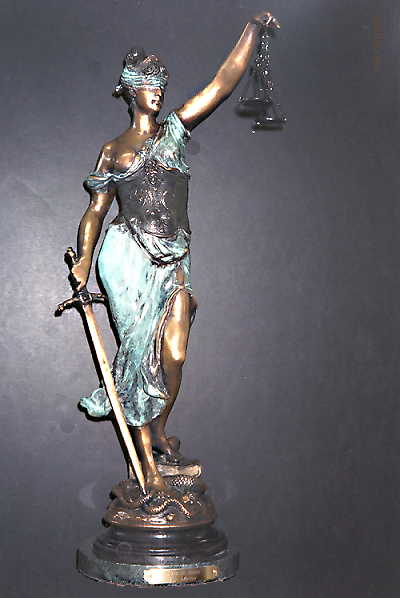
When Obama speaks of choosing Judges based off of their ‘empathy’ he neglects the purpose of the judges. Obama, a former law professor, completely ignores the reasoning behind our lady justice being blindfolded. The reason Justice is blind, is that it matters not what a person’s skin tone is, what their social status, wealth, fame, handicap, political preferences, sexual preferences and more are. Only justice matters.

It is unfortunate but when Barack Obama chooses a judge it will be in complete accordance with his world views, which he has elucidated very clearly to the American people and we are still buying into what he is selling. The only factor that Obama cannot forestall (yet) is time. It takes a lot of time for judges to retire, or die. If our country can sound the alarms now, it just might be enough time to alter the course of the way our constitution is upheld for the next 30 years.

Regrettably, our current media is on the side of destroying our constitution. In the last Sunday Denver Post an article written by Michael Riley outlines the grievous errors in all of our judgments. Governor Bill Ritter and two freshman senators asked Obama to “Seriously Consider” appointing Secretary Ken Salazar to the U.S. Supreme Court. What did they and the article cite were Salazar’s qualifications? That he is a “Westerner who from hard-scrabble beginnings has risen to become one of the country’s most successful Latino politicians.” The people pushing Salazar mainly are explaining his heritage, his skin color and his ability to rise from nothing to political bureaucrat. The article also points out that politicians and interest groups have been weighing in on their judgeship pick since Souter announced his retirement. Here is how they wish to ‘weigh in’ on who should be picked, “an African-American, a Latino, a woman, a liberal, to balance the court’s conservatives or a moderate who would sway from the middle.” This erases the most important qualification, which is whether the new judge will uphold our constitution. The article does point out that Salazar has never served as a judge but that doesn’t matter because Obama will consider real world experience when he is making his big choice.

The question our politicians should be asking our judges is not whether they will have empathy for the people they judge over, but whether or not they will uphold the constitution which protects all of our individual rights. The biggest danger for our country is not merely how a judge will vote on this or that issue, but whether they will undermine the very concept of the rule of law. Our country was founded on this idea. The idea that ‘laws not men’ govern. Once we erode this concept, our very ability to live as free people is wiped away.

Sunday, May 24, 2009

Anti Trust Part Two


In Part two I will go over such cases as the Alcoa Case, Borden Case, and Californias 2001 energy scare. Read part One HERE

ALCOA CASE (1945)

The Aluminum Company of America was one of the few corporations which successfully attained and held a monopoly on a product. This of course depends on how the market is defined. It is true that because of certain production patents Alcoa owned they were able to become the only producer of ‘primary’ aluminum, this they were able to hold for almost 20 years. In 1888 aluminum had no known uses, although its potential was obvious. The main problem was the extreme expense and the scarcity of the product. In the beginning, it would cost $5 to $8 dollars per pound, and Charles Hall (the man who discovered and patented the first commercial method for making aluminum) was unable to get more than 10 pounds produced a day. Because of this expense aluminum ingots were all but obsolete since it was unable to effectively compete with cheaper substitutes. However, by extremely effective entrepreneurial efforts they were able to produce 50 pounds a day by 1889, and over 1000 pounds a day in 1892, and by 1897 over 8000 pounds a day. Subsequently the price fell from $5 dollars in 1887 all the way to 37 cents by 1910, and by 1941 it fell all the way to 15 cents a pound.[1] Through Alcoa’s own ingenuity they were able to promote several uses for its product including; metal in the wire industry, for surgical instruments and other medical apparatus, and for fabrication into cooking utensils.

Alcoa was also accused of practicing many discriminatory business practices, but once again the facts tell another story. The making of aluminum ingots was very difficult and there are certain natural resources which were, and still are, needed. One claim against Alcoa was that it had monopolized bauxite deposits (used for mining the ore). Another claim was that they had monopolized water power sites, also that they conspired with a foreign cartel of producers.

The first case against Alcoa brought about by the Federal Trade Commission in 1925 was found to be in favor of Alcoa. The FTC examiner proved that Alcoa did not have a monopoly on bauxite deposits “there being sufficient supplies of bauxite in the world, exclusive of respondent’s holdings.” Also that Alcoa did not hold a monopoly on water power as “its holdings now being only a small percent of the available water power in the world.” Lastly it was found that Alcoa “never attempted to control and does not now control the market for foreign aluminum in the U.S”[2]

So this begs the question, why was Alcoa, after already being found innocent of all the claims, suddenly in 1945 convicted of being a monopoly and forced to break apart? Due to the lengthy and complex nature of the lawsuits against Alcoa a special act was passed on June 9th, 1944 which allowed a U.S. Circuit Court of Appeals to hear the case rather than the Supreme Court. The previous court of appeals found that if the market is defined not only by ‘primary’ ingot but also including secondary or ‘scrap’ ingot (also highly used at the time) Alcoa’s market share was a mere 33 percent, hardly a monopoly. The new Judges, headed by Judge Learned Hand, thusly reduced the relevant market to include only virgin ingot, which Alcoa was the sole supplier of in America. Alcoa supplied 90 percent of the virgin ingots in America, 10 percents came from foreign supplies. As Dr. Armentano shows

This broke familiar legal and economic guidelines as to the meaning of
‘monopolize’ and to the ‘relevant’ market under consideration. A relevant market
for a product ‘should include all firms whose production has so immediate and
substantial an effect on the prices and production of the firms in question that
the actions of the one group cannot be explained without direct reference to the
other. One should include in a market all firms whose products are, in fact,
good and directly available substitutes for one another in sales to some
significant group of buyers and exclude all others.[3]

So in essence, Judge Learned Hand had basically changed the way monopolies were discussed at the time, minimized the relevant market share and because of this came to the conclusion that in this skewed view of the market, Alcoa now was a monopoly. Once again the reality showed something different, Alcoa had in fact reduced prices and increased output, Judge Hand was condemning Alcoa for being too efficient and too good. In Judge Hand’s famous indictment of Alcoa he said:


It was not inevitable that it should always anticipate increases in the demand
for ingot and be prepared to supply them. Nothing compelled it to keep doubling
and redoubling its capacity before others entered the field. It insists
that it never excluded competitors; but we can think of no more effective
exclusion than progressively to embrace each new opportunity as it opened, and
to face every newcomer with new capacity already geared into a great
organization… (Emphasis mine)[4]

By condemning our most productive members of society for being too good and too efficient we are distorting the best use of our capital in America, while at the same time endorsing less efficient business practices and condemning the best within us. It is impossible for a businessman to start a business and know ahead of time whether or not he is going to break some arbitrary anti-trust law and go to jail or lose his investment. This brief history illustrates where anti-trusts have come from and two of their most disastrous cases, now it is important to understand the main underlying themes that are regularly attacked by anti-trust legislation.

VERTICAL AND TYING AGREEMENTS

In order to understand some of the damage anti-trust has caused it is important to get a full grasp on a few of the supposed negative consequences of a free and open market. The idea that a company will rise up and eventually gain enough power to discriminate in price and make vertical, and tying agreements is in actuality not a bad thing but in many cases a very effective way to allocate resources to their most efficient uses.

THE BORDEN CASE

Price discrimination is when some firm sells a product, usually homogeneous to different buyers at different prices Dr. Armentano’s case study of The Borden Evaporated Milk Case shows the irrationalities of attempting to enforce laws against price discrimination. In 1958 Borden was indicted for selling their product to different buyers at different prices. They had charged a smaller price for their milk that they had packed and sold to private-label customers than what they had charged for its own Borden brand of milk in retail stores. It is true that the milk sold to both buyers was chemically the same, ‘consumer perception’ of that same milk sold at retail was definitely not the same. “Consumers were willing to pay more for the Borden brand of evaporated milk than for milk packed by Borden but sold under various private labels.”[5] The reason for this is that Borden had at that point established a high reputation for their products. When Borden sold their products to private label companies their responsibility ended when the product left their factories, with their own product they were highly controlled on how they maintained the quality of milk they sold to their retail consumers. As Armentano notes the most important aspect of this case was that no one was injured by the lower prices charged to private-label distributors. Borden’s private-label costumers did not suffer by having a cheaper product, and Borden’s own costumers did not suffer by purchasing a high quality well known brand for slightly higher, especially when they could have switched to a cheaper brand of evaporated milk if they chose, also Borden only maintained an 11 percent market share in the Midwest.

The main complaints came from smaller less efficient Midwest firms who were losing business because of Borden’s efficiency. What had occurred is what happens nearly every time with anti-trust legislation, some smaller company complaining of a larger company that is lowering prices and providing a better product to their costumer’s, which is in turn negatively effecting their business. In fact over 90 percent of all anti-trust lawsuits are brought about by one private company suing another company.[6] Although the case was dismissed in 1967 this began to lead anti-trust legislation in a new direction, that of protecting high-cost rivals against lower-cost and more efficient companies.

CALIFORNIA’S 2001 ENERGY CRISIS

In 2001 there was a great scare that California, specifically the prosperous Silicon Valley, would possibly be shut down. That event could have shut down America’s whole economy. The reasons lauded at the time were the so called deregulation of the energy market in California. A bill was introduced to alleviate the problem, AB 1890. The fact is that bills like AB 1890 did not deregulate but simply shift regulations, and actually added a vast array of new regulations on power generators and distributors. AB 1890 is another attempt to reign in some form of ‘pure competition.’ Under AB 1890 it is not possible for energy companies to combine their generation with their distribution business. Editor of The Intellectual Activist Robert W. Tracinski said in an article,
They were forced to sell off many of their power plants. Any power they still
generated on their own had to be sold on the open market at prevailing prices –
with no special discounts for themselves. The result is that power distributors,
like Pacific Gas and Electric (PG&E) and Southern California Edison, were
made utterly dependant on the prices charged by independent generators. They
couldn’t fall back on their own, less-expensive supply.[7]

The other detrimental aspect of AB 1890 was to restrict long term contracts. This section of the bill would not allow a company to negotiate certain contracts which are vital to their organization. These long term contracts allow for the companies to lock-in a price agreement to protect themselves from sudden price changes in their industry. This however is perceived to give them ‘market power’ so it is not allowed. The last of the important intrusions into the business sector AB 1890 allowed for was to cap the price power distributors could charge. This is because under the anti-trust theory of ‘perfect’ competition, prices will always go down. The end result was that when prices spiked power distributors were unable to raise prices and this caused a shortage in the supply of energy, which resulted in the rolling blackouts and the scaring of the American public with thoughts of their biggest money makers having to ‘shut down.’

The lesson here is that anti-trust legislation doesn’t always have to be specifically used in order to affect all types of industries. It is the ideologies behind anti-trust legislation which need to be refuted.[8]

MICROSOFT AND MARKET SHARE

In the majority of anti-trust cases a few terms are used loosely, such as what constitutes a monopoly and what a company’s market share really is. For example in the Microsoft case at the turn of the century Microsoft’s market was defined as “that for computer operating systems for stand-alone personal computers using microchips of the kind manufactured by Intel.”[9] This narrowly defined market share completely left out any relevant competitors such as the operating systems used by Apple as well as other operating system competitors produced by; Sun Microsystems or the Linux system for stand-alone computers. The companies who have effectively defined Microsoft’s market share this way were able to prove that Microsoft had a dominant market share and thusly a monopoly power. In order to fully understand the Microsoft case it’s vital to know the history of the governments ‘assault on Microsoft.’

Beginning in 1990 the Federal Trade Commission began to investigate Microsoft, but did not file any charges. Because the FTC is charged with ‘policing’ so-called unfair practices this investigation helped lead to the subsequent anti-trust laws Microsoft had to deal with in later years. It was later found by the Justice Department that because Microsoft ‘per processor licensing fee had a 2 year lease on it this discouraged the manufacturers of PC’s from installing competitive software, which lead to the ‘unfair’ harm on rival software companies. Instead of dealing with a long legal debate Microsoft decided to shorten its 2 year leases to 1 year.

Almost immediately thereafter Microsoft was under new anti-trust litigation for tying its products. Microsoft was not accused of increasing prices or for reducing output, they were explicitly accused of the exact opposite.
The anti-trust lawsuit, however, did not accuse Microsoft of jacking up prices
unconscionably, in the classic manner of monopoly theory. Rather, Microsoft had
added an Internet browser to its Windows operating system free of charge,
undermining rival browser producer Netscape.[10]

Yet somehow the anti-trust enthusiasts claimed this harmed consumers because it harmed competition. The fact is, what Microsoft had done was succeed at beating out its rivals and was therefore condemned for their actions. Competition can be defined as “the effort of two or more parties acting independently to secure the business of a third party by offering the most favorable terms”[11] Microsoft was not engaging in any evil business practices by offering their customers to purchase their product which would include a free internet browser on top of their other services; the only ones harmed would be internet browser companies such as Netscape, who helped initiate the suit. The Microsoft lawsuit was a blatant protectionist attempt. In 1998 however, the lawsuit was found in favor of Microsoft. Afterwards, the Department of Justice and twenty states filed an anti-trust suit against Microsoft. The reason for their lawsuit was that the ‘aggrieved’ claimed Microsoft had an unfair monopoly in operating systems. Again, this unfair monopoly was using the loose and narrowly defined market for Microsoft, and a loose definition of monopoly. To determine whether or not Microsoft actually had any real monopoly it is necessary to properly define what a monopoly is. In reality a perfect monopoly would have a complete control of all supply of a product in a well defined market which had strong legal barriers to entry.[12]

A couple facts, even in their narrowly defined market Microsoft only had 90 percent of the operating system licensing for PC’s. There were also no legal barriers to entry and there were several rather large operating system competitors. The problem is, many proponents of anti-trust claim that a monopoly is any company that has a 70 percent market share; again this depends on how the market is defined. In an article by Professor Thomas Sowell he showed the ‘economic’ reality of market share. Explaining that during the time of the trial the city of Munich had ‘replaced Microsoft Windows with a Linux operating system in 14,000 of its computers.”[13] This showed that Microsoft was most definitely under pressure from competitors and did not have any relevant monopoly.

The use of these ‘murky’ and ever shifting definitions are where anti-trust legislation gets most of its power. Under the Sherman Act a ‘monopoly’ is not illegal per se, it is ‘monopolization that is made illegal. So even if a company is producing a superior product, is cutting costs, reducing prices, and increasing output they can be prosecuting under anti-trust legislation. What needs to be found out is whether or not the company achieved their monopoly through free enterprise ingenuity and business foresight, or through scrupulous business practices such as receiving special government franchises, patents, and subsidies. When looking at Microsoft it is apparent that the company achieved its market share through aggressive innovation and by promoting their standardized operating system that included various other applications. These applications included; file sharing, fax utilities, network support and more. These applications were previously purchased separately, which cost consumers more. Microsoft had effectively integrated all of these services into a ‘bundle’ package which consumers obviously enjoyed. This was the real source of any of Microsoft’s power, and did not exclude others from coming into the market and innovating their own operating systems, which is what now is occurring.

So in the end by defining the market share so narrowly and having such a shifty definition of monopoly we have allowed one of America’s most innovative companies to be greatly harmed. The effective allocation of resources was once again forced to flow to less efficient venues. Instead of allowing Microsoft to offer a superior, cheaper product through free trade, anti-trust laws have forced consumers to continue to purchase their web browsers separately, in effect costing them not only cash but resources which could have shifted to more useful avenues.

CONCLUSION

If our goal as an economy is the most efficient allocation of scarce resources which have alternative uses, then the only way to allow for such efficiency is to ensure that those in our economy who are risking their capital, time, and energy are free to do whatsoever they can to increase productivity, reduce costs, reduce prices and also increase output which will moreover allow these companies to effectively compete in an open and free market. As long as there is no interference into the marketplace from the government, and the only thing the government is allowed to do is protect individual rights, through ensuring fraud is punished and patents are protected. Then if this is our goal it is important to not only refute anti-trust legislation but the ideology behind them.

Business practices such as; price collusion, price discrimination, mergers, tying and others allows for companies to stay on the ‘competitive’ edge. It does not lead to some coercive monopoly where a company is able to ‘force’ out other companies and ensure there are no new entrants into their market. The only organization which has a monopoly on force is the government, and only through government power are monopolies ever possible.

By allowing anti-trust legislation to continue we condemn business men to being guilty for the mere fact that they are in business. As philosopher Ayn Rand summarized:

Under the [U.S.] antitrust laws, a man becomes a criminal from the moment he
goes into business… if he charges prices some bureaucrats judge as too high, he
can be prosecuted for… ‘intent to monopolize’; if he charges prices [too low],
he can be prosecuted for ‘unfair competition’ or ‘restraint of trade’; and if he
charges the same price as his competitors he can be prosecuted for ‘collusion’
or ‘conspiracy’[14]

Any corporation that is allowed to produce freely will inevitably act in their own best interest, and their best interest will be the best interest of their customers. Since a company can only offer products better and cheaper than the competition there can be no way to force any individuals to purchase their product and help continue them on the way to monopoly prices. The shoulders’ on which all our lives depend, the producers, are under constant attack and we must as free people protect these individuals who give us so many life enhancing and life saving products and services. The Henry Fords, John D. Rockefellers, Andrew Carnegies, Bill Gates’ and more are not to be lauded as evil greedy businessmen, but to be rewarded and applauded for their business ingenuity and innovativeness.

ENDNOTES


[1] Armentano Dominick T. Antitrust and Monopoly: Anatomy of a Policy Failure [Book]. - New York : John Wiley & Sons, Inc, 1982. Pgs 100-103

[2] Armentano Dominick T. Antitrust and Monopoly: Anatomy of a Policy Failure. Pg 104

[3] Armentano Dominick T. Antitrust and Monopoly: Anatomy of a Policy Failure. Pg 111

[4] Greenspan Alan Antitrust pg 72

[5] Armentano Dominick T. Antitrust: The Case for Repeal. Pg 72

[6] Paul Ron and Armentano Dominick Anti-Trust and monopoly [Interview]. - Jul 13, 1983.
[7] Tracinski Robert W. Capitalism Magazine [Online] // Capitalism Magazine. - Jan 22nd, 2001. - Oct 14th, 2008. - http://www.capmag.com/article.asp?ID=159.
[8] Cunha Mark Da Capitalism Magazine [Online]. - June 10th, 2001. - Oct 14th, 2008. http://www.capmag.com/article.asp?ID=922
[9] Sowell Thomas Basic Economics: a Common Sense Guide to the Economy 3rd edition [Book]. - New York : Basic Books, 2007. Pg 156
[10] Sowell Thomas Basic Economics: a Common Sense Guide to the Economy 3rd edition Pg 156

[11] Armentano Dominick T. Antitrust and Monopoly: Anatomy of a Policy Failure. Pg 14

[12] Armentano Dominick T. Antitrust: The Case for Repeal

[13] Sowell Thomas Capitalism Magazine [Online] // Capitalism Magazine. - June 28th, 2003. - Dec 13th, 2007. - http://www.capmag.com/article.asp?ID=2892.
[14] Rand Ayn America's Persecuted Minorty: Big Business [Book Section] // Capitalism: The Unknown Ideal. - New York : Signet, 1961

Friday, May 22, 2009

Anti-Trust Part One


There are a set of laws in America that are believed to increase productivity and efficiency in the economy. These laws are called anti-trust laws, and they include; The Sherman Act, The Clayton Act, The Federal Trade Act and many more. The ideologies and their subsequent laws have subjugated our best producers to irrelevant and counterproductive practices. Alan Greenspan in 1961 called the anti-trust laws “reminiscent of Alice’s Wonderland: everything seemingly is, yet apparently isn’t, simultaneously. It is a world in which competition is lauded as the basic axiom and guiding principle, yet ‘too much’ competition is condemned as ‘cutthroat.’”[1]
Anti-trust in essence is a set of laws to ensure that competition is kept on a more even keel. That there can be no business which comes to power and ‘monopolizes’ any industry i.e. has complete control over said industry. Anti-trust legislation derives much of its intellectual power from a few ideas. One being the idea of ‘pure’ or ‘perfect’ competition; this is the idea that the best and most efficient market is one in which there are many sellers of a product all who make no real profit and who have absolutely no effect on the market price. Economists for over a hundred years have been building models off of this idea, coming to conclusions based off faulty assumptions. Some of the assumptions used, by economists, are noted in Dr. Armentano’s book Antitrust and Monopoly: “The model begins by assuming that a substantial number of small firms already exist in some relevant market, and that they are already producing homogeneous products.”[2] As was said earlier these atomistic firms have no control over the market price since the products are all homogenous (the products are the same in the eyes of the consumers). This also means that although in the short run some economic profits are possible, under these assumptions in the long run what is called “normal” profits will occur. Normal profits means marginal revenue will equal marginal costs and there will be no real profits made in an industry because entry and exit into this particular industry is open and easy.

The idea of a ‘pure’ competitive market is not what most economists believe is absolutely necessary. They do not think that the market needs to be so extremely competitive, in this sense, but simply that they use this idea as a benchmark to determine efficiency. They claim we need certain regulatory policies to help us bring in a more ‘purely’ competitive market.

Another area these legislations get their power from, which also derives from the ‘pure’ competition idea, is the idea that such things as mergers (vertical), tying agreements, gouging, product differentiation, advertising, price discrimination and more are all considered detrimental to a free and pure competitive market. Anti-trust laws are set out to destroy these business practices.

The Sherman act of 1890, which is the first industrial policy in America, had an effect on American businesses which is almost impossible to fully perceive. The way in which the law is stated and implemented is all but impossible to actually follow within the guidelines, in other words, the Sherman Anti-trust Act is absolutely arbitrary. To quote section two of the Sherman Act “Monopolizing trade a felony.”:


Every person who shall monopolize or attempt to monopolize, or combine to
conspire with any other person or persons, to monopolize any part of the trade
or commerce among the several states, or with foreign nations, shall be deemed
guilty of a felony. (Emphasis mine)[3]

As Greenspan said in his essay:
No one will ever know what new products, processes, machines, and cost-saving
mergers failed to come into existence, killed by the Sherman Act before they
were born. No one can ever compute the price that all of us have paid for that
Act which, by inducing less effective use of capital, has kept our standard of
living lower than would otherwise have been possible.[4]

By implementing this law America has subjected the producers to the whim of any judiciary or politician who wishes to ‘make an example’ of those who they perceive are being greedy or unethical in some manner.

The Clayton Act of 1914 specifically stopped tying agreements and mergers that would allow a company to attain a ‘majority’ of the market. A tying agreement is when one company leases or sells a product with the sole agreement that the purchaser shall buy or lease some other product sold by the producer. Mergers, usually either horizontal or vertical, are also condemned. Vertical mergers occur when a manufacturer of some product purchases the distribution centers for its products such as the retail stores that sell it. One of the largest and best known of this type of merger was the Standard Oil Company which had in effect owned almost everything needed to produce and distribute their product, kerosene.

Proponents of anti-trust legislation explain that horizontal agreements; such as joint ventures, price agreements and horizontal mergers, are a root cause for economic inefficiency which can reduce output and increase price. Generally this is taken into effect using what is called the ‘rule of reason’ in which the courts decide the probable social costs possibly being lost if the merger is not allowed. The social costs can be very high; these mergers can bring about substantial cost savings in production and distribution, also in industrial research and product development. Also they may come up with entirely new products and services that might otherwise not be possible.

HISTORY

The idea that there was a need for the government to interfere in the market in order to ensure there was this ideal type of competition, mainly started after the Civil War. The railroads played a big hand in the coming of anti-trust legislation and over one hundred and forty years of government interference in the business sector. In the eastern United States before the civil war the railroads had to deal with heavy competition. This not only included other railroads but also other forms of transportation, including barges, riverboats, and wagons. In the 1860’s there was an outcry to move the railroads to the west, and therefore connect California to the rest of the country. The railroads however, did not see enough profit in building all that was needed to make the move to California, especially not simply for ‘the public interest.’ This brought about the government subsidizing the railroads and in essence giving them the edge they needed to become a monopoly. During the time between 1863 and 1867 the Federal government granted the railroads close to one hundred million acres of public lands, and these lands granted were given to specific individually owned railroads, which gave that particular company the ability to break away from the competition of the other railroads, as well as the other forms of transportation.[5]

These government aided railroad companies in the west were able to act like a ‘true’ monopoly in the very textbook sense of the word. Again, this arbitrary power they had accrued was made possible exclusively because of the government interference into the transportation industry. As the west grew however, it opened up the transportation field to more competition, which the railroads had a hard time dealing with. This is where an “Ominous turning point had taken place in our economic history: the Interstate Commerce Act of 1887”[6] This act in effect allowed the government to all but fully control the railroad industry. It is still thought to this day that these regulations were necessary because of the obvious monopoly the railroads had, but the reality is that the monopoly the railroads were able to attain came directly from government interventionist policies. This then lead to the belief that the government had to continue to regulate the business industry. These same beliefs eventually led to Americans fear of the formidable “trusts.” A trust is a legal entity that owns several smaller companies each with their own duties in the larger trust. The most formidable and well known of these was the Standard Oil Trust ran by John D. Rockefeller.

THE MYTH OF THE STANDARD OIL MONOPOLY

The majority of the myth of the greedy and monopolistic company Standard Oil actually stemmed from a woman named Ida Tarbell a journalist in the early 20th century. Ms. Tarbell perpetuated the myth that before Rockefeller came on to the scene the petroleum industry was a perfectly competitive market and the men involved all enjoyed great and prosperous lives. Ms. Tarbell tells with vivid detail of the men, using many real names, which had been involved and had enjoyed with confidence their achievements, and she exclaims that these men looked forward to the future of their industry with eagerness and joy, then, as Tarbell explains it:
…Suddenly, at the very heyday of this confidence, a big hand [Rockefeller’s]
reached out from nobody knew where, to steal their conquest and throttle their
future. The suddenness and the blackness of the assault on their business
stirred to the bottom their manhood and their sense of fair play.[7]

This view propelled the hatred for large trusts and especially Standard Oil. This is still believed mostly true to this day. As philosopher Alex Epstein explains in his article Vindicating Capitalism: The Real History of the Standard Oil Company. “Pick a modern history or economics book at random and you are likely to see some variant of the Lloyd/Tarbell narrative being taken for granted.”[8]

Standard Oil was accused of many things including; predatory pricing, receiving special rebates from railroads, collusion, and more. As the story continues these ‘predatory’ and ‘anti-competitive’ practices forced companies to sell their holdings to Standard Oil or risk losing everything. It was almost as if Rockefeller was holding a gun to their heads. This idea has convinced the majority of people that in a openly free market it is possible for a corporation to come into existence that will take over all else and become a ‘coercive’ monopoly, similar to the power a government has.
Ron Chernow author of the popular Rockefeller biography Titan; says, “[Rockefeller] had taught the American public an important but paradoxical lesson: Free markets, if left completely to their own devices can wind up terribly unfree.”[9]

As Epstein explains this is “the logic behind antitrust law, in which government uses its political power to forcibly stop what it regards as ‘anticompetitive’ uses of economic power.”[10]

This standard story of the Standard Oil Company is completely false, Standard did not ever have a monopoly, the company was still subject to the laws of supply and demand, and the railroad rebates they received were not evil business practices but the product of extremely good foresight and ingenuity. Moreover, Rockefeller’s Standard Oil revolutionized the way business was conducted and led the way to the ever increasingly high standard of living American’s today enjoy.

Before Standard came on the scene most people had to light their houses with sperm whale oil, which was very expensive, usually only the rich could afford such things. The majority of the world had to stop any productive activities once it got dark. Once petroleum was discovered to have certain properties to allow for long lasting light, mainly kerosene, it allowed for a whole new world to open up. People now had easier access to light and could enjoy such activities as reading at night, among other amusements, especially in the winter season.

At the beginning of the petroleum industry the process of refining and distributing kerosene was, as expected, very crude. The refiners had used, for storage, expensive barrels costing upwards of $2.50 a barrel; they would then load them onto barges, wagons or railroads, each having to make numerous stops, since the majority of these refiners could only produce a few barrels at a time. Along the way to their destination, these barrels would often fall off, leak, and even explode. Even after finally making it into the homes of customers the kerosene would still explode and kill many people, this was a huge problem in the 1860’s and even 70’s. This problem is actually the reason Rockefeller named his company ‘Standard Oil.’[11] These early refiners also were very inefficient in the distillation of crude oil. Usually using only a small fraction of the actual oil, the fraction was usually kerosene, and the rest was thrown away.

Rockefeller came on the scene and almost immediately began cleaning up the mess that was the petroleum industry. Some of the major accomplishments are diametrically opposed to the rhetoric most hear on the subject of Standard Oil. For one, Standard did not restrict output nor did it stop any new competition from entering the market. A little known fact is that Standard’s market share in petroleum refining declined from “roughly 85 percent in 1890 to 64 percent in 1911. In 1911, at least 147 refining companies were competing with Standard, including such large [vertically integrated] firms Gulf, Texaco, Union, Pure, Associated Oil and Gas, and Shell.”[12] It is interesting to note that when the anti-trust case against Standard was initiated in 1911 all this was going on. Yet Standard was still forced to break up their holdings and was put at a large disadvantage with their competitors, at no real fault of their own. Another important fact to note was that instead of the popular myth that Standard had achieved a monopoly power and thusly began to raise prices, it did the exact opposite. Standard had lowered costs and consequently lowered prices, “Prices for kerosene fell from 30 cents a gallon in 1869 to 9 cents in 1880, 7.4 cents in 1890, and 5.9 cents in 1897.”[13]

What happened to Standard is very logical when looked at in a historical setting. There was a large shift in two areas which affected Standard. One was the invention and mass production of the light bulb and the subsequent electricity boom. This had a large impact on Standard Oil mainly because the company’s main revenue source, kerosene, was becoming more and more obsolete. The second source of a shift away from Standard Oil was the different uses for crude oil, Standard had a hard time keeping up with; this of course was the use of gasoline. What all this shows is that anti-trust legislation was not the cause of Standard’s decline, but the open and free market was.

If one is to try and study Standard it is important to first understand what Standard oil specifically did to improve upon the industry. When Rockefeller first invested in the refining of oil in 1863 he did not set up shanty refineries as did most people at the time, he instead invested and created the largest refinery in Cleveland: Excelsior Works. Almost immediately Rockefeller was improving the distillation process and was soon producing more than 505 barrels a day in opposition to most refiners at the time who were only producing around 5 barrels a day. He also bought land for his refinery in a place where he would be able to ship his oil by land and sea, which would come in handy later on when Rockefeller was negotiating with the railroads.

Probably one of the most important characteristics of Rockefeller was his keen accounting skills. He was able to drastically cut costs throughout his whole reign at the helm of Standard Oil. One way in which he accomplished this was by cutting costs of transporting oil in barrels. Instead of relying on the ‘unreliable’ barrel makers he simply began making his own barrels, this helped drop his costs for barrels from $2.50 to under $1 a barrel. He also hired and trained his own purchasing agents, “which eliminated the need for paying ‘jobbers’ (purchasing middleman)”[14]

All in all, Rockefeller’s Standard Oil Company did not monopolize nor destroy any industry. He in fact revolutionized the industry, cut costs, increased output, and drastically reduced prices; he also invented the idea of companies investing in research and development. For this he was punished and forced to break apart a business he spent a lifetime building. The impact of anti-trust laws on Standard Oil was very drastic, but unfortunately not the only time it has happened. It has happened repeatedly and dramatically throughout the history of anti-trust legislation. As was shown above Standard did indeed vertically integrate its operations, but this was not a ploy that was worthy of condemnation, but was worthy of praise. Standard achieved rebates from railroads not through so-called ‘scrupulous’ business practices, but through ingenious foresight and great business sense. In essence it was not any wrongdoing that Standard was condemned but in its efficiency.

Another famous anti-trust case, the Alcoa case of 1945, also illustrates the wrongdoing of these set of laws and the damage that occurs to businessmen’s lives.


In Part Two I will briefly go over other famous cases such as the Acloa case of 1945, The Borden Case, and some of the reaons behind California 2001 Energy crisis, including some other rather mushy problems these ideals incur.


ENDNOTES
[1] Greenspan Alan Antitrust [Book Section] // Capitalism: The Unknown Ideal / book auth. Rand Ayn. - New York : Signet, 1967. Pg 63
[2] Armentano Dominick T. Antitrust and Monopoly: Anatomy of a Policy Failure [Book]. - New York : John Wiley & Sons, Inc, 1982. Pg 15

[3] Anthony D. Becker Ph.D. The Antitrust Case Browser [Online]. - April 16th, 2004. - Sept 9th, 2008. - http://www.stolaf.edu/people/becker/antitrust/index.htm.
[4] Greenspan Alan Antitrust. Pg 71

[5] Greenspan Alan Antitrust. Pg 64-65

[6] Greenspan Alan Antitrust Pg 65

[7] Tarbell Ida THE HISTORY OF THE STANDARD OIL COMPANY [Online]. - 1904. - Oct 10th, 2008. - http://www.history.rochester.edu/fuels/tarbell/MAIN.HTM. Pgs 36-37
[8] Epstein Alex Vindicating Capitalism: The Real history of the Standard Oil Company [Journal] // The Objective Standard. - 2008. - pp. 29-65.
[9] Chernow Ron Titan [Book]. - Vintage : Random House, 2004. Pg 297
[10] Epstein Alex Vindicating Capitalism: The Real history of the Standard Oil Company

[11] Epstein Alex Vindicating Capitalism: The Real history of the Standard Oil Company
[12] Armentano Dominick T. Antitrust: The Case for Repeal [Book]. - Auburn : Ludwig Von Mises Institute, 1999. Pgs 40-43
[13] Armentano Dominick T. Antitrust: The Case for Repeal. Pg 41

[14] Epstein Alex Vindicating Capitalism: The Real history of the Standard Oil Company

[15] Armentano Dominick T. Antitrust and Monopoly: Anatomy of a Policy Failure [Book]. - New York : John Wiley & Sons, Inc, 1982. Pgs 100-103

[16] Armentano Dominick T. Antitrust and Monopoly: Anatomy of a Policy Failure. Pg 104

[17] Armentano Dominick T. Antitrust and Monopoly: Anatomy of a Policy Failure. Pg 111

[18] Greenspan Alan Antitrust pg 72

[19] Armentano Dominick T. Antitrust: The Case for Repeal. Pg 72

[20] Paul Ron and Armentano Dominick Anti-Trust and monopoly [Interview]. - Jul 13, 1983.
[21] Tracinski Robert W. Capitalism Magazine [Online] // Capitalism Magazine. - Jan 22nd, 2001. - Oct 14th, 2008. - http://www.capmag.com/article.asp?ID=159.
[22] Cunha Mark Da Capitalism Magazine [Online]. - June 10th, 2001. - Oct 14th, 2008. http://www.capmag.com/article.asp?ID=922
[23] Sowell Thomas Basic Economics: a Common Sense Guide to the Economy 3rd edition [Book]. - New York : Basic Books, 2007. Pg 156
[24] Sowell Thomas Basic Economics: a Common Sense Guide to the Economy 3rd edition Pg 156

[25] Armentano Dominick T. Antitrust and Monopoly: Anatomy of a Policy Failure. Pg 14

[26] Armentano Dominick T. Antitrust: The Case for Repeal

[27] Sowell Thomas Capitalism Magazine [Online] // Capitalism Magazine. - June 28th, 2003. - Dec 13th, 2007. - http://www.capmag.com/article.asp?ID=2892.
[28] Rand Ayn America's Persecuted Minorty: Big Business [Book Section] // Capitalism: The Unknown Ideal. - New York : Signet, 1961

Sunday, May 17, 2009

Student Cinefest Denver Colorado Production One Review


Upon entering the student Cinefest for spring ’09, our audience was treated to a mix of comedy, action, experimental and non-fiction, and that’s just for production I class. The show kicks off with a rather interesting futuristic movie about the end of man. Mainly, it is clips of a man smoking in front of a blue screen. Putting our narrator in dark at all times, where we can only see his outline. This gives us the impression he is in hiding. Although, it lacks a definite story line, plot or narrative in the movie, it does showcase the beginnings of one filmmaker’s possible career in futuristic thrillers. The film’s best actual element was the explosion sound transitioning between all cuts. This gave the audience a sense of the world they are now exploring. The major downside to this opening movie was the fact that there was absolutely nothing interesting about it visually – after the first 30 seconds. Once the audience got sick of watching some guy’s mouth and a cigarette we tune out to any meaningful through-line the author might have had, if any.
Overall, the movies for production I were a great success. All of the movies shown seemed to showcase these beginning filmmakers starting visions. The movies were rough, they were sometimes not edited together in a meaningful way, such as “Yes, Of Course I Speak English!” This movie is a great example of how one person can try and make something decent out of a lot of hardships in creating the film. “Rhapsody of a Life Extra” is a movie that shows how filmmakers can patch together meaning when they believe there is none in life. The two best movies of the night which elucidate good storytelling, effective mise-en-scene and great editing are Role Play and Three Stock Crossroads.


Three Stock Crossroads efficiently showcased a view of a desolate life in which there are no rights, and there is no reason to life. Although, personally, I am diametrically opposed to such ideas, their great use of cinematography brought me into their story, whether I liked it or not. The simple set, with three stocks holding three people out by a road in the middle of nowhere, worked great for the desolate feel they were going for. The exposure of the camera, which gave it a somewhat unrealistic feel, was even effective in drawing the audience in to what was going on.


The movie I wish to dive into a little bit more however, is Role Play. This movie starring Presley Conkle as an aging professor finally attempting to say his piece to his non-appreciative student body; utilizes great mise-en-scene elements, narrative flow, hilarious editing, great acting and more. When we are first introduced to Professor Harris he is running through the halls, this may just indicate a once in a while late person, however the opening shot of his feet and the falling paper, really giving us a sense of his character; lost and confused. The director then has us on an over-the-shoulder ride along with his character. To ensure we are feeling his tardiness we even see Harris attempt to look at his watch while running. When Harris finally gets to the door to his room, the editing (having been speeding up throughout his entire jog) speeds up rapidly, in successive cuts until he opens the door, begins talking, and we see he is talking to himself. The sound at the beginning is nothing but heavy footsteps and rustling paper, which serves to further elucidate his lonely and yet hectic life. By having the character run into a door further adds comedy in a way that helps the audience understand the kind of crazy lifestyle Harris is living. A great establishing shot is used after Harris enters the classroom and begins talking to his ‘class.’ The shot serves as one of the last straws to Harris’ psyche. Almost immediately afterwards he is seen talking to himself, as if teaching his class. Off screen a piece of crumpled up paper is thrown at Harris, and now begins his declaration of his feelings to the ‘invisible’ class. The edits are very nicely matched with the characters overall feeling, hot and fast when he hits on the beautiful women towards the end, slow and kind of scary when he splashes the latte on the innocent texting girl, and quite steady everywhere else.


The Make-up and wardrobe really helped this young actor look as if he were actually an aging professor. The close-up of his wrist watch and the sound of the clicking watch further exaggerate his absurd behavior. The end of the movie brings the character full circle, and shows that unfortunately he never really learned anything. Harris is stuck in his little world of pretending or ‘role-playing’ in his imagination the life he wished he could live. Although, the story might miss a few deep points it could touch upon, it is a well done project implementing many aspects learned in their first year.

Monday, May 4, 2009

Ayn Rands Playboy Interview (1964)


Ayn Rands Playboy Interview.

The 20th century Philosopher and Writer Ayn Rand, author of Mega-best sellers such as The Fountainhead and Atlas Shrugged, was interviewed by playboy in 1964. This particular interview – one of hundreds- is famous for it’s breadth. In it she discusses guild, original sin, emotions, motherhood, religion, morality, Romantic love, sex, hedonism, promiscuity, charity, compassion, literature, government, free will, foreign policy, nuclear treaties, politicians and others.

She also succinctly describes the practical application of her philosophy; objectivism.
It is now online HERE. Enjoy and send feedback!

Saturday, May 2, 2009

Water is a Toxic Pollutant?

Dr. Charles R. Anderson a materials physicist has posted a blog which logically links C02 being a pollutant to water being a pollutant. The problem is, as he points out, this logic isn’t actually very logical. Recently the EPA has claimed C02 is a pollutant. For those of you that remember science class in elementary school, we exhale C02 and plants ingest C02. As Dr. Anderson points out in his blog, the two of us kind of need each other. You may be wondering how he could come to the conclusion that based off the faulty logic of the EPA he has equated H20 is as much a pollutant as C02. Well, actually he shows how it more of a pollutant:

“Aside from the fact that the maximum absorption frequency for infrared radiation is somewhat different for CO2 and water vapor, their activities as greenhouse gases are very similar. Of course, water vapor has an effect which is about 18 to 20 times greater, owing largely to its about 100 times greater concentration in the atmosphere and its ability to form a wider range of dimers, trimers, and other forms to absorb infrared radiation across a broader spectrum than does CO2. So, if CO2 is a pollutant because it is a greenhouse gas, then so is water. We should next expect to see the EPA drawing up restrictions on the human use of water which may add to the water vapor concentration in the atmosphere. I would assume that this will mean no more farm irrigation and no more watering of lawns as a start. The formation of more lakes and ponds by man must also be stopped.”

He then explains the idea behind water being a toxin may be the problem. Lastly he concludes that the “EPA has taken the prize for the most irrational decleration of supposed science and economics ever.”

Honestly, that seems harder to believe, the government is responsible for some pretty irrational things. But, I’ll let you all decide whether you agree with Dr. Anderson or not. Read his full article HERE.

Friday, May 1, 2009

More Guns, Less Crime an interview with John Lott


Dr. John Lott interview


John Lott wrote the book More Guns, Less Crime. The book discusses the pertanent facts to gun ownership in America. Although, there are many anecdotal stories on both sides of the gun argument, Lott argues proper data is needed to infer decisions.
In an interview with John Lott he explicates his position on many of the dogmas perpetrated about guns in our politically correct climate:

Lott: Criminals are deterred by higher penalties. Just as higher arrest and conviction rates deter crime, so does the risk that someone committing a crime will confront someone able to defend him or herself. There is a strong negative relationship between the number of law-abiding citizens with permits and the crime rate—as more people obtain permits there is a greater decline in violent crime rates.


Lott defends his position by showing his study is the biggest crime study in American history. Covering over 18 years and including all 3,054 counties:
Lott: The analysis is based on data for all 3,054 counties in the United States during 18 years from 1977 to 1994


Lott’s analysis wipes away all of the prevalent beliefs made mainstream in our liberal media today. For example, the must believed ‘truth’ that most people are killed by someone they:


Lott: You are referring to the often-cited statistic that 58 percent of murder victims are killed by either relatives or acquaintances. However, what most people don't understand is that this "acquaintance murder" number also includes gang members killing other gang members, drug buyers killing drug pushers, cabdrivers killed by customers they picked up for the first time, prostitutes and their clients, and so on. "Acquaintance" covers a wide range of relationships. The vast majority of murders are not committed by previously law-abiding citizens. Ninety percent of adult murderers have had criminal records as adults.


His books, and subsequently the in depth research has been almost completely ignored by the media. One day we may all have to pay the price for such ignorance.

Read the whole interview here.